Showing posts with label Wharf Theatres. Show all posts

Wednesday, February 3, 2016

Epic Aussie Tale Challenges Notion of Otherness

I hope you had your weetbix this morning!


I’m sure when set designer David Fleischer pitched his concept for the Sydney Theatre Company’s production of The Golden Age he could not have helped but throw in a pun (or two) about actors getting their hands dirty. Why? Because almost the entire stage used to present this revival production of a Louis Nowra classic was taken up with a great big pile of dirt. Simplistic in concept, the design actually worked wonders for a play which traverses years and continents (and throws a little Greek tragedy in there for good measure).

When Nowra wrote the script, he likely envisaged set changes occurring behind the proscenium curtain. With no such luxury in the Wharf 1 theatre, Fleischer and Director Kip Williams instead employed the actors to set and remove a small array of props to denote each required location. Intriguingly, the prop carriers did not merely walk on and off stage in semi-darkness, hoping to go largely unnoticed by the audience. Instead, each scene change was carried out as a purposeful action; the branches representing the Tasmanian wilderness swayed gently in an imaginary breeze, the fence posts surrounding the sanatorium were driven violently into the dirt. This direction helped to maintain the pace and momentum of what is a very long and challenging work.

It is not just the staging that kept this production afloat, however, as all the cast members did an admirable job of keeping up their energy and commitment. You see, this play is an epic. Beginning in Hobart in the late 1930s, we follow two young men (played by Remy Hii and the supremely talented Brandon McClelland) into the West-Tasmanian wilderness, where they happen upon a small collection of motley Europeans who appear to have abandoned the trappings of modern society. The tribe has their own language - an odd mix of Scottish, Irish and Cockney English – and mythology.
Driven by curiosity (and unlikely love) the youths bring the strangers back to ‘civilisation’, and what follows is an exploration of insanity, the construct of war and what it means to be Australian. Did I mention this was an epic?!

McClelland does a bang-up job as the play’s leading man, effectively connecting past and present. But it is the characters of Ayre (Sarah Peirse) and Betsheb (Rarriwuy Hick) that are by far the most challenging in this work, not least because most of their dialogue is delivered in the tribe’s provocative and nearly-nonsensical language. The complexity of these Shakesperean-like roles was no doubt a joy to master, and Hick’s performance, in particular, had the audience revolted and enamoured in equal measure.

A special mention also goes to Ursula Yovich, who brilliantly inhabited the physicality of Elizabeth Archer (a genteel woman accustomed to dinner parties and theatrical fundraisers). Her mannerisms so perfectly mirrored those of my late grandmother (herself the perfect society hostess) that I was convinced they must have met.
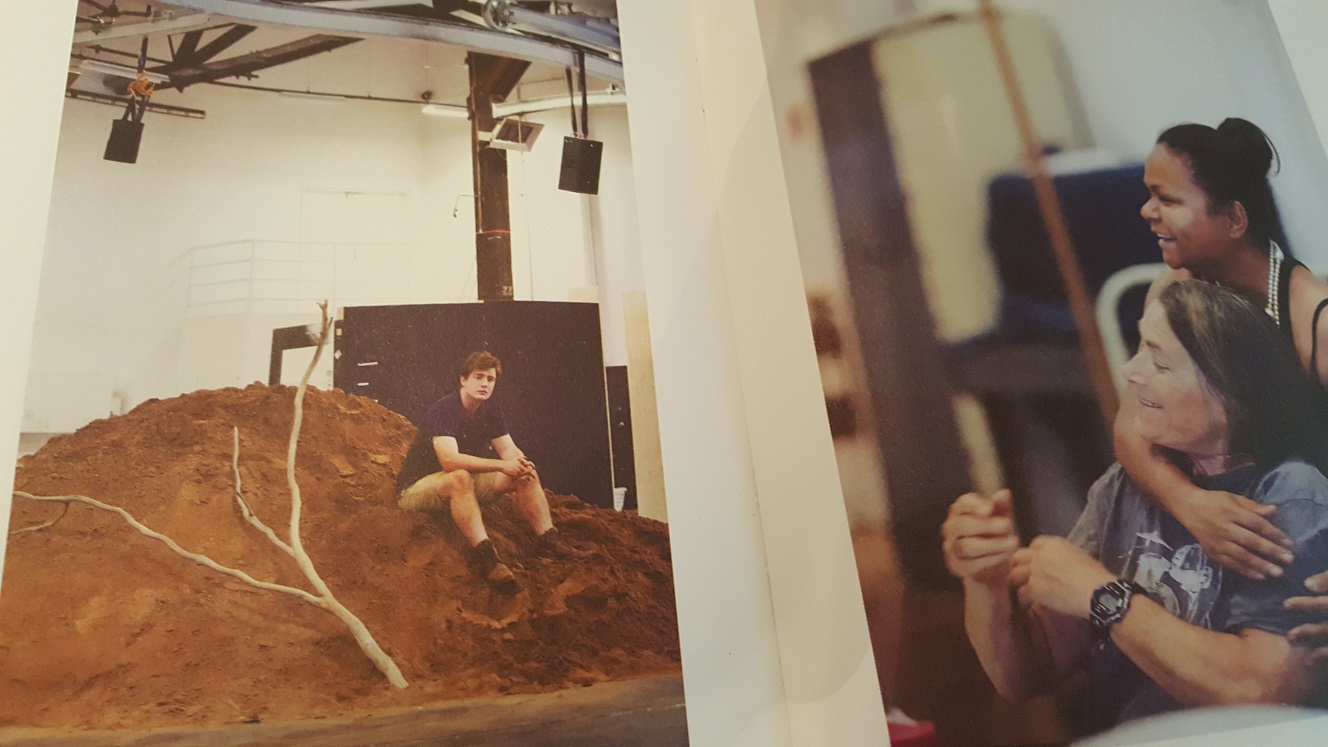

Composer/Sound Designer, Max Lyandvert, brought a cinematic quality to the soundscape, scoring much of the play and Damien Cooper’s lighting design was subtle but played a strong narrative role.

Overall, Williams has done well to convey a very convoluted, and perhaps overlong, story. I questioned the need for the nudity (of which the audience was forewarned, along with the smoke effects and gunshots) but felt overall the play was in good hands. In his program notes, Williams said he was particularly conscious of how the play speaks to Australia’s national identity. Attended by this reviewer a few days out from Australia Day it was not hard to uncover this deeper meaning. Perhaps a concept further challenged by the casting of Indigenous actors in traditional ‘white’ roles.

But I believe the play speaks more strongly to the issue of mental illness and whether ‘crazy’ also means ‘dangerous’. With the story told against the backdrop of World War II, you are pushed unrelentingly towards the notion that people who do not operate according to society’s conventions are inferior to others. Many may not be aware that, during his reign, Hitler not only culled thousands of Jews, but also the mentally ill, deformed and homosexual. Today, we continue to persecute the non-conformists, through our laws, service funding and our attitudes. And we’re still participating in ugly wars in foreign lands, sacrificing our young in the name of protecting a nation and its shared ideals – whatever they may be.


Thought provoking and challenging, I congratulate the STC for taking on such an epic. It won’t be for everyone – but ironically doesn’t this play prove that there is no ‘everyone’?

Saturday, April 25, 2015

Boys Will Be Boys - But Should Girls?

Can women ever really play in a man’s world?

This is the premise of Melissa Bubnic’s Boys Will Be Boys – a play about a female stockbroker who believes she is taking it to the boys, and beating them at their own game.

Having spent most of my working life in the finance sector, I, along with my fellow theatre-going party, saw a familiar world unfolding on stage. We had come from an early dinner, during which the four of us discussed our respective workplaces, with two of our group noting their firms were currently recruiting women for senior management roles. That’s right – in order to meet their gender equality/diversity quotas, two major finance institutions were under strict orders to interview only women for the open positions. We were eager to see how our reality was going to be portrayed on stage.

Bubnic’s play takes us into the fast-living, fast-selling world of broking, where clients are pawns to be manipulated, careers are based on who not what you know, and the big deals are won and lost in the back rooms of strip clubs. The lead character, Astrid, has wriggled her way into this world, seemingly on her own terms. She takes on a junior, a girl named Priya in whom it appears Astrid sees something of herself. Together, they navigate the boys club, adopting the old line about Ginger Roger’s as a mantra: ‘She did everything Fred Astaire did, just backwards and in high heels’.

The cast is all female – a decision which forces the audience to examine their own attitudes towards ‘working’ women (in all senses of the word), and sexism. An uncomfortable early scene featuring an almost naked Zindzi Okenyo (who just five minutes earlier was playing Harrison, the son of a wealthy client who is bullied by his new employers) made me question my own feelings about the female form. Would I have felt as embarrassed for this actress if there were no men in the audience at all? And when Tina Bursill crossed the stage in a skimpy blue leotard, breasts thrust forward, did I, like many women in the audience, give her a subtle murmur of approval, acknowledging her bravery? When women use their bodies to generate influence – or to make money – is it empowering as Priya suggests, or simply perpetuating the idea of the victim?

The actors spent the majority of the show in tailored pant suits – the three supplementary characters in bold green, blue and peach, standing out against the white and grey of our protagonist and her protégé. This choice was no doubt made to help the supporting cast demonstrate their masculinity, juxtaposed against their occasional forays into sequinned leotards. The only hint of femininity about our leads was the shiny black heels they strutted the stage in. But in reality, the business women of today, particularly those in senior positions, opt for bright colours, prints and strong but feminine statement pieces. It’s not uncommon to see bright pink pencil skirts, silk blouses, bold floral patterns printed across knee-length, structured dresses and heavy knit bolero jackets in white or cream. I wondered if our leads could have benefited from a more womanly look, but in the end this did not detract from the overall design of the show.

In the Director’s Q&A, featured in the program, Paige Rattray talks about how she dealt with the challenge of staging the piece, which slips regularly from boardroom, to strip club, to hotel bar – as the narrative unfolds - to cabaret theatre in which we hear Astrid’s ‘inner monologue’. “Basically, we had to try to create a space that we could shift between those two worlds really quickly,” Rattray explains. The end result was a wide, sparsely furnished office space, complete with fluorescent lighting tiles and likely-fake pot plant. Astrid’s cabaret moments are treated in situ, with the addition of a microphone, mirror ball and fog machine at varying intervals. Personally, I think the transitions could have been done more effectively by actually introducing a cabaret set to a small corner of the theatre, most likely downstage; this would have permitted the audience to more easily forgive Astrid’s crude but flirtatious dialogue and passable singing voice.

That is not to say that Danielle Cormack’s performance as Astrid was flawed – it just could have benefited from more polish around the vocals. Perhaps this will come over time – the play had only opened two days prior. This also meant that the cast tripped over their dialogue occasionally, a blemish easily forgiven. Otherwise the performances were strong, and all parts well-cast. Cormack’s Astrid was both hard-arsed and likeable, with just enough subtly that you could believe she was neither victim nor villain. Sophia Roberts as Priya was perhaps a little rigid and naïve, but this was as much to do with the script as her interpretation.

The most interesting character was Isabelle, played beautifully by Meredith Penman. The high-class hooker tells Astrid straight up that she’s not in ‘Pretty Woman’ and there will be no rescuing, and it is through her eyes that we see just what playing in a man’s world can do to a woman. This is not because of how Isabelle makes her living, but due to her treatment at the hands of Astrid. The iron-clad exterior Astrid has assumed makes her somehow more masculine than her male colleagues; a character trait made worse because we feel she should know better.

The script has potential, but perhaps needs a little more time to reach its goal. Why, for example, have Priya tell the lamest, tamest jokes to the delight of her male clients while they downed liquor ahead of the expected floor show? Similarly, why are those same nameless men portrayed as clowns, buffooning around an office party (Christmas?) like naughty boys? They are not sinister, nor realistic. Was Bubnic trying to avoid victimising men, or was she saying they are actually quite harmless? Or was the intent to play down these interactions so that they did not take away from the main game – the relationship between Priya and Astrid? Either way, I was not convinced.

In the real world, a woman is afforded perhaps a little more credit for her success than was shown to Astrid, but then again, there is absolutely a ‘behind her back’ conversation that goes on between men about their female counterparts in the finance sector. I have witnessed the blokey attitudes, the drinking culture and the innuendo-laden laughter first-hand. So do I think a woman can play in a man’s world? Perhaps a better question is – why should she want to? If I have to turn a blind eye to behaviours that make my stomach churn simply to succeed in a job, then I have to question why on earth I would want to do that job in the first place? If I wanted to be a broker, why couldn’t I start my own, female-only firm, with only female clients? Why not play on my terms, instead of someone elses? Instead of trying to beat men at their own game, why don’t women start their own league, with their own rules – ones that suit their particular strengths and abilities? I thank Bubnic and the team from STC for challenging me with these questions. 

Details
Viewed: 22 April 2015
Venue: Wharf 2 Theatre
Author: Melissa Bubnic
Director: Paige Rattray
Company: Sydney Theatre Company