Showing posts with label Sarah Peirse. Show all posts

Wednesday, February 3, 2016

Epic Aussie Tale Challenges Notion of Otherness

I hope you had your weetbix this morning!


I’m sure when set designer David Fleischer pitched his concept for the Sydney Theatre Company’s production of The Golden Age he could not have helped but throw in a pun (or two) about actors getting their hands dirty. Why? Because almost the entire stage used to present this revival production of a Louis Nowra classic was taken up with a great big pile of dirt. Simplistic in concept, the design actually worked wonders for a play which traverses years and continents (and throws a little Greek tragedy in there for good measure).

When Nowra wrote the script, he likely envisaged set changes occurring behind the proscenium curtain. With no such luxury in the Wharf 1 theatre, Fleischer and Director Kip Williams instead employed the actors to set and remove a small array of props to denote each required location. Intriguingly, the prop carriers did not merely walk on and off stage in semi-darkness, hoping to go largely unnoticed by the audience. Instead, each scene change was carried out as a purposeful action; the branches representing the Tasmanian wilderness swayed gently in an imaginary breeze, the fence posts surrounding the sanatorium were driven violently into the dirt. This direction helped to maintain the pace and momentum of what is a very long and challenging work.

It is not just the staging that kept this production afloat, however, as all the cast members did an admirable job of keeping up their energy and commitment. You see, this play is an epic. Beginning in Hobart in the late 1930s, we follow two young men (played by Remy Hii and the supremely talented Brandon McClelland) into the West-Tasmanian wilderness, where they happen upon a small collection of motley Europeans who appear to have abandoned the trappings of modern society. The tribe has their own language - an odd mix of Scottish, Irish and Cockney English – and mythology.
Driven by curiosity (and unlikely love) the youths bring the strangers back to ‘civilisation’, and what follows is an exploration of insanity, the construct of war and what it means to be Australian. Did I mention this was an epic?!

McClelland does a bang-up job as the play’s leading man, effectively connecting past and present. But it is the characters of Ayre (Sarah Peirse) and Betsheb (Rarriwuy Hick) that are by far the most challenging in this work, not least because most of their dialogue is delivered in the tribe’s provocative and nearly-nonsensical language. The complexity of these Shakesperean-like roles was no doubt a joy to master, and Hick’s performance, in particular, had the audience revolted and enamoured in equal measure.

A special mention also goes to Ursula Yovich, who brilliantly inhabited the physicality of Elizabeth Archer (a genteel woman accustomed to dinner parties and theatrical fundraisers). Her mannerisms so perfectly mirrored those of my late grandmother (herself the perfect society hostess) that I was convinced they must have met.
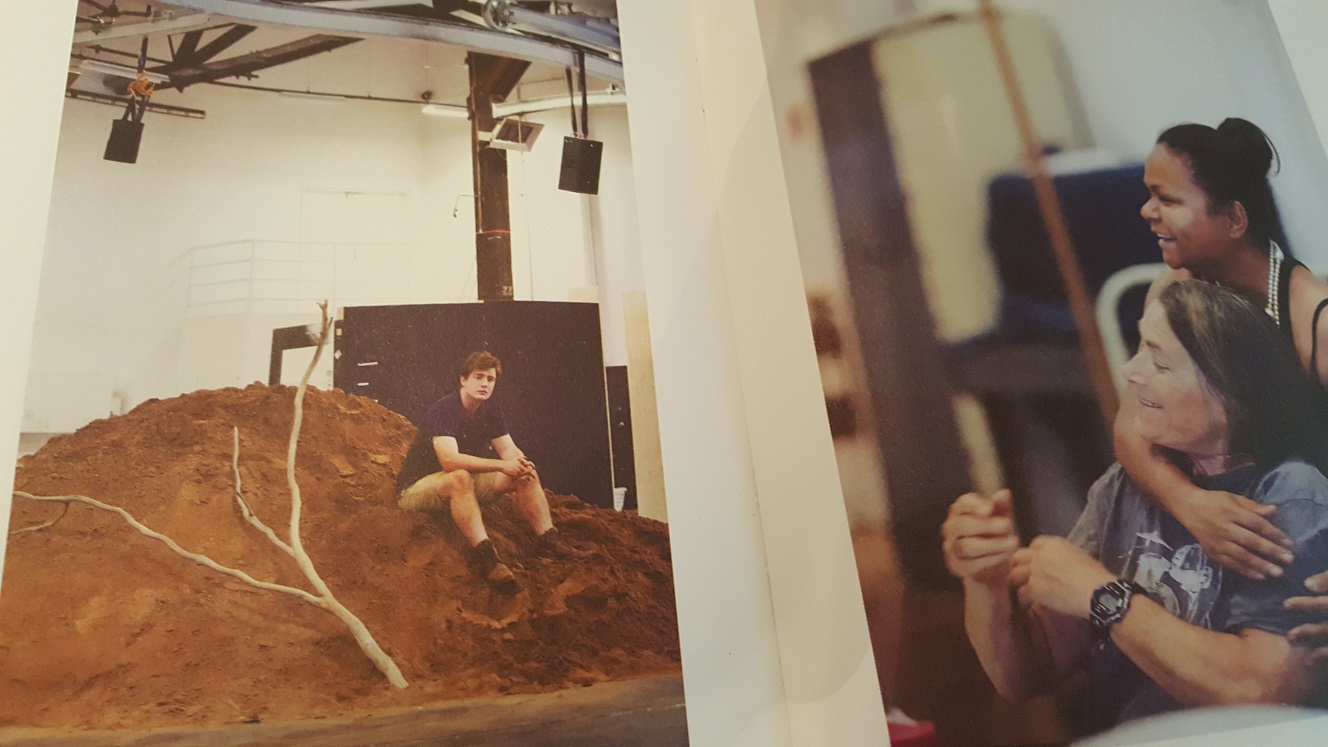

Composer/Sound Designer, Max Lyandvert, brought a cinematic quality to the soundscape, scoring much of the play and Damien Cooper’s lighting design was subtle but played a strong narrative role.

Overall, Williams has done well to convey a very convoluted, and perhaps overlong, story. I questioned the need for the nudity (of which the audience was forewarned, along with the smoke effects and gunshots) but felt overall the play was in good hands. In his program notes, Williams said he was particularly conscious of how the play speaks to Australia’s national identity. Attended by this reviewer a few days out from Australia Day it was not hard to uncover this deeper meaning. Perhaps a concept further challenged by the casting of Indigenous actors in traditional ‘white’ roles.

But I believe the play speaks more strongly to the issue of mental illness and whether ‘crazy’ also means ‘dangerous’. With the story told against the backdrop of World War II, you are pushed unrelentingly towards the notion that people who do not operate according to society’s conventions are inferior to others. Many may not be aware that, during his reign, Hitler not only culled thousands of Jews, but also the mentally ill, deformed and homosexual. Today, we continue to persecute the non-conformists, through our laws, service funding and our attitudes. And we’re still participating in ugly wars in foreign lands, sacrificing our young in the name of protecting a nation and its shared ideals – whatever they may be.


Thought provoking and challenging, I congratulate the STC for taking on such an epic. It won’t be for everyone – but ironically doesn’t this play prove that there is no ‘everyone’?

Sunday, May 3, 2015

But What Does it Mean?

We’re not beginning to… to… mean something?

Mean something! You and I, mean something! Ah, that’s a good one!

If there is a quote that sums up Beckett better than the above from ‘Endgame’ then I haven’t heard it. Just when you think you’re starting to make some sense of the seemingly nonsensical dialogue-driven, physically challenging theatrical diatribe that is the hallmark of Beckett’s work, the author changes direction with barely a twitch and you’re left once again puzzled and inadequate. Make sense? Absurd!

Which is not to say that his plays are not enjoyable. You don’t need to understand something in order to enjoy it. But it’s usually advisable.

With this in mind, I wittingly attended Sydney Theatre Company’s production of Endgame, starring Hugo Weaving as Hamm. ‘This won’t make sense half the time,’ I kept saying to myself. ‘Just treat it like modern dance – admire the physical form of the performers, the way they deliver the message persuasively even if you don’t know what it is, appreciate the moments of humour.’

I was right; it didn’t make sense half the time. But wow! What a performance!! Trying to explain Endgame is like trying to put a leash on a pug – be prepared for wiggles and squirms and snorts. I know because I tried both this afternoon. For the purpose of this review, though, it is vital that you understand that the play centres around Hamm, an elderly gentleman who spends the entire performance sitting centre stage in an armchair with wheels, his legs immobile and his eyes hidden by blacked-out glasses.

Any actor that tackles this role is already facing an uphill challenge – how do you deliver a compelling performance without the ability to pace the stage or convey emotion with just a look? Add to this a script that turns back and around on itself, making learning it (let alone creating meaning from it) a seemingly interminable task, and you have some idea of the position Hugo Weaving found himself in.

So I would already have praised any actor attempting this role, even if their performance was mediocre, due to sheer force of will. But no – Weaving was far from mediocre. His Hamm was measured, controlled, playful, thoughtful, charming, and undeniable. His gestures were superbly rendered, both large and small, bringing humour to a character that could easily be pitied. His vocal delivery was flawless, with volume and aggression applied sparingly, interspersed by lip smacks and fillers that brought realism to the absurd.

In fact, Hamm could very well have been my father, viewed in a future where his body is failing, and he has only his overactive but befuddled mind to keep him company. A writer, yes, but more importantly a storyteller, who delights in demonstrating his professorial knowledge of everything, despite perhaps no longer really ‘knowing’ anything at all. Weaving delivered him to us perfectly.

His fellow actors, also bodily restricted, gave strong performances. I have always loved Bruce Spence, and his face (the only part of his body really visible throughout Endgame as his character Nagg is confined to a bin) was suitably elastic. Sarah Peirse (Nell) was delightful, conjuring her youthful love affair with Nagg so vividly through only her eyes (again due to her position within a bin). Tom Budge, in his STC debut, delivered a comical, controlled Clov, which reminded me of some of the best physical theatre I have seen in my time. His was the hardest character to ‘get to know’, but I doubt this was Budge’s fault (although as this is my first live viewing of Endgame it’s hard to tell).

Nick Schlieper’s set and lighting design was really the other star. Using the height of the Roslyn Packer Theatre (previously known as Sydney Theatre) to his advantage, Schlieper delivered a cold but strangely comforting tower, with viewless windows, stagnant water and a sense of a world without life. The lighting was subtle but superbly done, focusing the audience’s attention at the appropriate moments without overwhelming the restricted cast.

In place of a picture of director Andrew Upton in the program is a photograph of some of the key props from the production, arranged comically about Hamm’s armchair. Sitting on the seat is The Dog (a mangy, matted toy, missing one leg, used to tremendous comic effect during the show). He is wearing Hamm’s glasses and at his feet rests Nagg’s biscuit. This image perfectly reflects Upton’s treatment of this play – set the pieces perfectly but let the man in the chair tell the story.

A real treat.


Details
Viewed: 28 April 2015
Venue: Roslyn Packer Theatre
Author: Samuel Beckett
Director: Andrew Upton
Company: Sydney Theatre Company