Showing posts with label STC. Show all posts

Monday, March 14, 2016

What's Wrong With Playing it Safe?

“He says his aim is poetry. One does not aim at poetry with pistols. At poets, perhaps...” 

One of the things that I often notice when watching a theatrical comedy is that there is always one actor who doesn’t quite get it. Timing is, as they say, everything, and there are some actors who can’t quite pick-up the rhythm. But I am delighted to report that this was not the case in STC’s latest production of Tom Stoppard’s Arcadia.

Not only did every single cast member held their own in the comedy stakes, they also managed to convincingly deliver both the poetry and convoluted mathematical concepts that riddle the script. Even Wil McDonald as Gus Coverly and Augustus Cloverly, who spent the majority of the show in silence, drew many the snicker and giggle. 

The standouts (because there are always one or two) were Ryan Corr, who delivered insult after insult with genuine relish (particularly as they flew over the heads of their intended) and Michael Sheasby, who’s portrayal of Valentine Cloverly was delightfully geeky. He handled the complex theoretical monologues with ease, and he evoked in this reviewer a genuine desire to run up and just give him a big hug.

Julie Lynch deserves an award for her beautiful costumes – it’s lovely to see period clothing in its rightful place for a change. Michael Scott-Mitchell’s set design received criticism from some because of the extremely long table which extended over the majority of the stage. However, I think the table worked to create a strong contrast between the arm’s length nature of male-female relationships in the 1800s and the cosy familiarity within which we engage with one another today. I also think he deserves credit for Plautus/Lightening, the tortoise who all but steals the show.

This was a well-produced, well-cast, well-designed show. You would think that should make an audience happy – particularly when the play is a comedy – but I couldn’t help but feel that last Wednesday night’s audience was a little faint with their applause. In the same vein as a Ron Howard film, you can’t really fault it, but it’s not something you’ll be talking about forever and a day. Maybe that’s a fault of the script, which effectively predicts the demise of the world as we know it (a bit of a downer), or maybe the Sydney theatre-going public have grown too used to controversial, out-there design and incomprehensible directorial choices. Whatever the reason, I felt alone in my admiration of the experience. Perhaps I just appreciate the pleasant change when a director plays by the book, literally.

I do have one criticism though – how come the tortoise didn’t get a bow?

Details
Viewed: 9 March 2016
Venue: Drama Theatre, Sydney Opera House
Author: Tom Stoppard
Director: Richard Cottrell
Production Company: STC

Monday, February 15, 2016

The Secret River Second Time Around

This play does more to 'close the gap' than any Government report ever could

It’s not very often that you have the opportunity to attend a theatrical production that you know is going to be great – actors, directors and scripts can often promise much but significantly under-deliver. However, as I had seen the original season of STC’s The Secret River I knew that the repeat run would make for a brilliant night out. Having previously subjected my bestie to an absolutely traumatic previous theatre experience (Belvoir’s Wizard of Oz), I couldn’t wait to show her that theatre can be both art and entertainment.

The Secret River follows William Thornhill, a London thief transported to New South Wales in the early 1800s. Earning his freedom, Thornhill settles himself and his young family on what he believes to be unclaimed land on the edge of the Hawkesbury River. But the land is already inhabited by the Dharug people. What unfolds is a compelling and at times confronting story that has been played out hundreds of times in our nation’s history.

But it is the creative team who make this production truly memorable. In the same way that Julie Taymor transfigured the cartoon world of Simba in her production of The Lion King, Director, Neil Armfield, and his designers (Set Designer Stephen Curtis, Lighting Designer Mark Howett and Sound Designer Steve Francis) have given us a staging that is both practical and brilliant. The backdrop is at once a towering escarpment and an ancient gum, its branches stretching out of sight. Smouldering sticks dragged over the sandstone-coloured floor give us territories and boundaries, easily erased by childish play. Lighting transports us from river to bank, and the sounds of the bush are recreated by mouth, bucket and spade. This is theatrical play at its best.

Listing the production highlights to my friend – the brilliantly clever design elements, the interweaving musical soundtrack, and the profound performances – I saw her face slowly fall. She politely declined my invitation.

What I failed to understand in my enthusiasm for the production is that I am white. My ancestors were free settlers who built the foundations of what is now Hobart. Sure, there may be some political prisoners in my distant, Irish past, but on the whole, my family have had it pretty good. My friend, however, is descended from the Wiradjuri people, the largest Indigenous Nation within New South Wales. For her, the story of Australian colonisation is not entertainment. It triggers an anger and sorrow that I cannot adequately describe, something she was not keen on bringing to the surface.

Armfield recalls a similar encounter in his program notes, describing how Indigenous actress Ursula Yovich knocked him back twice when he asked her to join the original production. In a letter to Armfield, Yovich wrote:

“The play brings up a lot of hurt. We all know the history, what comes next. The hurt comes from the knowledge that the actions portrayed at the end of the play (although so very long ago) have had a huge domino effect, even to this day… The trauma is so deep that we believe our own worthlessness…”

Yovich did eventually relent and her performance in the first run of this play was superb. One of the reasons behind her change of heart appears to have been the sensitivity she knew Armfield and his team would bring to the production.

The strongest example of this empathetic hand is the voice that playwright Andrew Bovell has given to the Dharug people. In the original and critically acclaimed novel by Kate Grenville, from which the story is taken, the Indigenous people are kept at arm’s length from the reader. We see the events almost entirely through the eyes of Thornhill; a victim of circumstance and class who now has a chance to obtain the status and respect he covets.

In Bovell’s script, the Dharug characters are not only named, but given prominence. They open the play, letting us eavesdrop on a casual fireside conversation. They appear again at regular intervals, giving us some insight as to how they interact with the land and these strangers who have come to claim it. Through these vignettes we see that they are not so different from the whites.


We also see a vision of what could have been, of partnership and shared knowledge, depicted through the actions of the youngest Thornhill, Dick (Toby Challenor/Heath Jelovic), and the ‘first’ river settler, Blackwood (Colin Moody). Dick has yet to be indoctrinated into the world of savages and gentlemen; his innocent, child’s eyes see people who know the secrets of the land and how to work it to their advantage. Blackwood declares that his Indigenous partner is more of a wife to him than his first ever was, and suggests that Thornhill learn the principle of ‘give a little, take a little’.

But this is not a story of triumph over the wilds of the land – this is a war for territory between two tribes and we already know who will be victorious. It is easy to sit back in judgement of these early settlers and criticise their actions, but the beauty of this production is the mirror it holds up to its audience. In Thornhill (played with strength and subtlety by Nathanial Dean) we see how easily a man’s morality can shift when he has something to believe in and defend. Can any of us really say we would have acted differently? More importantly, how little of this story do we actually know?

I hope that this production triggers something in its audience – a guilt, and a profound sense of inadequacy. We should know more about these first people. We should understand their language without the need for surtitles (which I am delighted to report the production does not resort to). We should acknowledge the wrongs our forefathers committed, no matter how innocent their motives. We should be teaching this history in schools. We should be honouring Indigenous stories in our museums and galleries.

I thank Armfield and the STC for taking Thornhill’s story to another level, and my friend for helping me see it through different eyes, which at the conclusion of the play were this time filled with tears. 

Details
Viewed: 4 February 2016
Venue: Roslyn Packer Theatre, Walsh Bay
Author: Kate Grenville
Adapted by: Andrew Bovell
Director: Neil Armfield
Production Company: Sydney Theatre Company


Wednesday, February 3, 2016

Epic Aussie Tale Challenges Notion of Otherness

I hope you had your weetbix this morning!


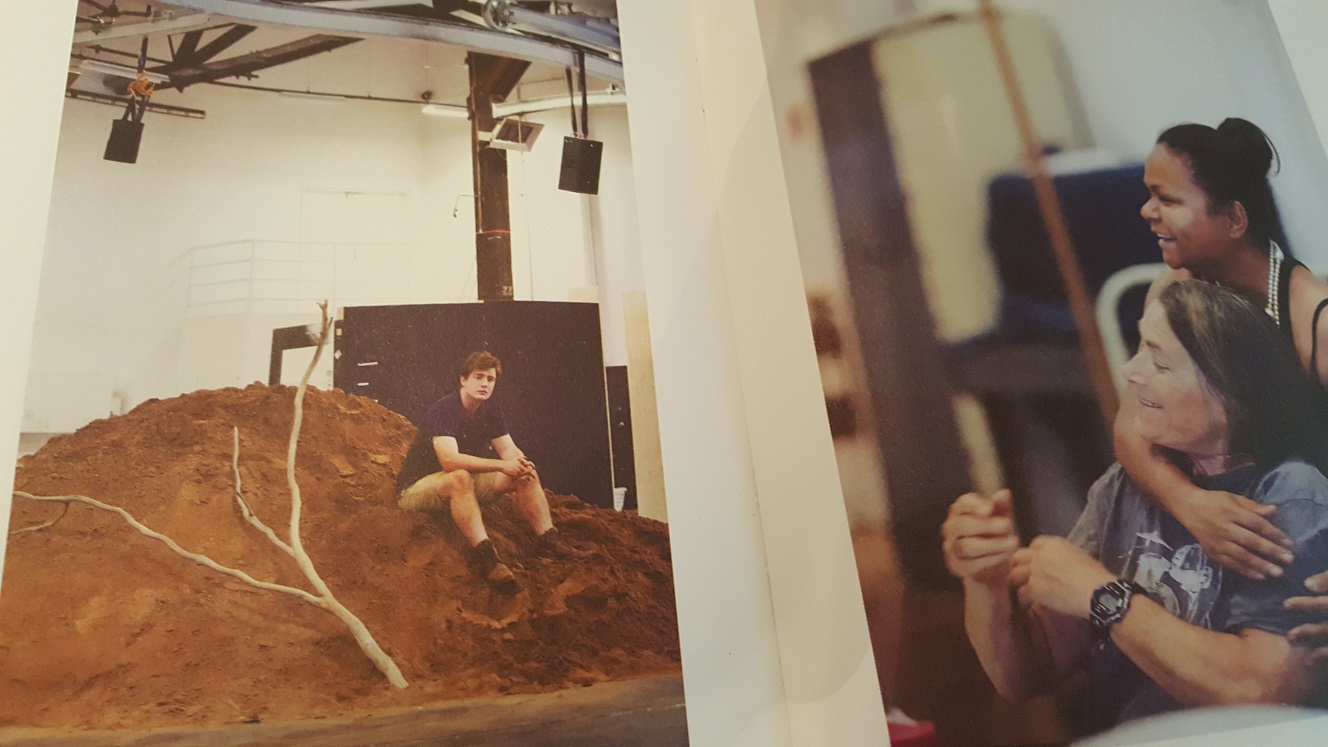
I’m sure when set designer David Fleischer pitched his concept for the Sydney Theatre Company’s production of The Golden Age he could not have helped but throw in a pun (or two) about actors getting their hands dirty. Why? Because almost the entire stage used to present this revival production of a Louis Nowra classic was taken up with a great big pile of dirt. Simplistic in concept, the design actually worked wonders for a play which traverses years and continents (and throws a little Greek tragedy in there for good measure).

When Nowra wrote the script, he likely envisaged set changes occurring behind the proscenium curtain. With no such luxury in the Wharf 1 theatre, Fleischer and Director Kip Williams instead employed the actors to set and remove a small array of props to denote each required location. Intriguingly, the prop carriers did not merely walk on and off stage in semi-darkness, hoping to go largely unnoticed by the audience. Instead, each scene change was carried out as a purposeful action; the branches representing the Tasmanian wilderness swayed gently in an imaginary breeze, the fence posts surrounding the sanatorium were driven violently into the dirt. This direction helped to maintain the pace and momentum of what is a very long and challenging work.

It is not just the staging that kept this production afloat, however, as all the cast members did an admirable job of keeping up their energy and commitment. You see, this play is an epic. Beginning in Hobart in the late 1930s, we follow two young men (played by Remy Hii and the supremely talented Brandon McClelland) into the West-Tasmanian wilderness, where they happen upon a small collection of motley Europeans who appear to have abandoned the trappings of modern society. The tribe has their own language - an odd mix of Scottish, Irish and Cockney English – and mythology.
Driven by curiosity (and unlikely love) the youths bring the strangers back to ‘civilisation’, and what follows is an exploration of insanity, the construct of war and what it means to be Australian. Did I mention this was an epic?!

McClelland does a bang-up job as the play’s leading man, effectively connecting past and present. But it is the characters of Ayre (Sarah Peirse) and Betsheb (Rarriwuy Hick) that are by far the most challenging in this work, not least because most of their dialogue is delivered in the tribe’s provocative and nearly-nonsensical language. The complexity of these Shakesperean-like roles was no doubt a joy to master, and Hick’s performance, in particular, had the audience revolted and enamoured in equal measure.

A special mention also goes to Ursula Yovich, who brilliantly inhabited the physicality of Elizabeth Archer (a genteel woman accustomed to dinner parties and theatrical fundraisers). Her mannerisms so perfectly mirrored those of my late grandmother (herself the perfect society hostess) that I was convinced they must have met.


Composer/Sound Designer, Max Lyandvert, brought a cinematic quality to the soundscape, scoring much of the play and Damien Cooper’s lighting design was subtle but played a strong narrative role.

Overall, Williams has done well to convey a very convoluted, and perhaps overlong, story. I questioned the need for the nudity (of which the audience was forewarned, along with the smoke effects and gunshots) but felt overall the play was in good hands. In his program notes, Williams said he was particularly conscious of how the play speaks to Australia’s national identity. Attended by this reviewer a few days out from Australia Day it was not hard to uncover this deeper meaning. Perhaps a concept further challenged by the casting of Indigenous actors in traditional ‘white’ roles.

But I believe the play speaks more strongly to the issue of mental illness and whether ‘crazy’ also means ‘dangerous’. With the story told against the backdrop of World War II, you are pushed unrelentingly towards the notion that people who do not operate according to society’s conventions are inferior to others. Many may not be aware that, during his reign, Hitler not only culled thousands of Jews, but also the mentally ill, deformed and homosexual. Today, we continue to persecute the non-conformists, through our laws, service funding and our attitudes. And we’re still participating in ugly wars in foreign lands, sacrificing our young in the name of protecting a nation and its shared ideals – whatever they may be.


Thought provoking and challenging, I congratulate the STC for taking on such an epic. It won’t be for everyone – but ironically doesn’t this play prove that there is no ‘everyone’?

Sunday, May 3, 2015

But What Does it Mean?

We’re not beginning to… to… mean something?

Mean something! You and I, mean something! Ah, that’s a good one!

If there is a quote that sums up Beckett better than the above from ‘Endgame’ then I haven’t heard it. Just when you think you’re starting to make some sense of the seemingly nonsensical dialogue-driven, physically challenging theatrical diatribe that is the hallmark of Beckett’s work, the author changes direction with barely a twitch and you’re left once again puzzled and inadequate. Make sense? Absurd!

Which is not to say that his plays are not enjoyable. You don’t need to understand something in order to enjoy it. But it’s usually advisable.

With this in mind, I wittingly attended Sydney Theatre Company’s production of Endgame, starring Hugo Weaving as Hamm. ‘This won’t make sense half the time,’ I kept saying to myself. ‘Just treat it like modern dance – admire the physical form of the performers, the way they deliver the message persuasively even if you don’t know what it is, appreciate the moments of humour.’

I was right; it didn’t make sense half the time. But wow! What a performance!! Trying to explain Endgame is like trying to put a leash on a pug – be prepared for wiggles and squirms and snorts. I know because I tried both this afternoon. For the purpose of this review, though, it is vital that you understand that the play centres around Hamm, an elderly gentleman who spends the entire performance sitting centre stage in an armchair with wheels, his legs immobile and his eyes hidden by blacked-out glasses.

Any actor that tackles this role is already facing an uphill challenge – how do you deliver a compelling performance without the ability to pace the stage or convey emotion with just a look? Add to this a script that turns back and around on itself, making learning it (let alone creating meaning from it) a seemingly interminable task, and you have some idea of the position Hugo Weaving found himself in.

So I would already have praised any actor attempting this role, even if their performance was mediocre, due to sheer force of will. But no – Weaving was far from mediocre. His Hamm was measured, controlled, playful, thoughtful, charming, and undeniable. His gestures were superbly rendered, both large and small, bringing humour to a character that could easily be pitied. His vocal delivery was flawless, with volume and aggression applied sparingly, interspersed by lip smacks and fillers that brought realism to the absurd.

In fact, Hamm could very well have been my father, viewed in a future where his body is failing, and he has only his overactive but befuddled mind to keep him company. A writer, yes, but more importantly a storyteller, who delights in demonstrating his professorial knowledge of everything, despite perhaps no longer really ‘knowing’ anything at all. Weaving delivered him to us perfectly.

His fellow actors, also bodily restricted, gave strong performances. I have always loved Bruce Spence, and his face (the only part of his body really visible throughout Endgame as his character Nagg is confined to a bin) was suitably elastic. Sarah Peirse (Nell) was delightful, conjuring her youthful love affair with Nagg so vividly through only her eyes (again due to her position within a bin). Tom Budge, in his STC debut, delivered a comical, controlled Clov, which reminded me of some of the best physical theatre I have seen in my time. His was the hardest character to ‘get to know’, but I doubt this was Budge’s fault (although as this is my first live viewing of Endgame it’s hard to tell).

Nick Schlieper’s set and lighting design was really the other star. Using the height of the Roslyn Packer Theatre (previously known as Sydney Theatre) to his advantage, Schlieper delivered a cold but strangely comforting tower, with viewless windows, stagnant water and a sense of a world without life. The lighting was subtle but superbly done, focusing the audience’s attention at the appropriate moments without overwhelming the restricted cast.

In place of a picture of director Andrew Upton in the program is a photograph of some of the key props from the production, arranged comically about Hamm’s armchair. Sitting on the seat is The Dog (a mangy, matted toy, missing one leg, used to tremendous comic effect during the show). He is wearing Hamm’s glasses and at his feet rests Nagg’s biscuit. This image perfectly reflects Upton’s treatment of this play – set the pieces perfectly but let the man in the chair tell the story.

A real treat.


Details
Viewed: 28 April 2015
Venue: Roslyn Packer Theatre
Author: Samuel Beckett
Director: Andrew Upton
Company: Sydney Theatre Company

Saturday, April 25, 2015

Boys Will Be Boys - But Should Girls?

Can women ever really play in a man’s world?

This is the premise of Melissa Bubnic’s Boys Will Be Boys – a play about a female stockbroker who believes she is taking it to the boys, and beating them at their own game.

Having spent most of my working life in the finance sector, I, along with my fellow theatre-going party, saw a familiar world unfolding on stage. We had come from an early dinner, during which the four of us discussed our respective workplaces, with two of our group noting their firms were currently recruiting women for senior management roles. That’s right – in order to meet their gender equality/diversity quotas, two major finance institutions were under strict orders to interview only women for the open positions. We were eager to see how our reality was going to be portrayed on stage.

Bubnic’s play takes us into the fast-living, fast-selling world of broking, where clients are pawns to be manipulated, careers are based on who not what you know, and the big deals are won and lost in the back rooms of strip clubs. The lead character, Astrid, has wriggled her way into this world, seemingly on her own terms. She takes on a junior, a girl named Priya in whom it appears Astrid sees something of herself. Together, they navigate the boys club, adopting the old line about Ginger Roger’s as a mantra: ‘She did everything Fred Astaire did, just backwards and in high heels’.

The cast is all female – a decision which forces the audience to examine their own attitudes towards ‘working’ women (in all senses of the word), and sexism. An uncomfortable early scene featuring an almost naked Zindzi Okenyo (who just five minutes earlier was playing Harrison, the son of a wealthy client who is bullied by his new employers) made me question my own feelings about the female form. Would I have felt as embarrassed for this actress if there were no men in the audience at all? And when Tina Bursill crossed the stage in a skimpy blue leotard, breasts thrust forward, did I, like many women in the audience, give her a subtle murmur of approval, acknowledging her bravery? When women use their bodies to generate influence – or to make money – is it empowering as Priya suggests, or simply perpetuating the idea of the victim?

The actors spent the majority of the show in tailored pant suits – the three supplementary characters in bold green, blue and peach, standing out against the white and grey of our protagonist and her protégé. This choice was no doubt made to help the supporting cast demonstrate their masculinity, juxtaposed against their occasional forays into sequinned leotards. The only hint of femininity about our leads was the shiny black heels they strutted the stage in. But in reality, the business women of today, particularly those in senior positions, opt for bright colours, prints and strong but feminine statement pieces. It’s not uncommon to see bright pink pencil skirts, silk blouses, bold floral patterns printed across knee-length, structured dresses and heavy knit bolero jackets in white or cream. I wondered if our leads could have benefited from a more womanly look, but in the end this did not detract from the overall design of the show.

In the Director’s Q&A, featured in the program, Paige Rattray talks about how she dealt with the challenge of staging the piece, which slips regularly from boardroom, to strip club, to hotel bar – as the narrative unfolds - to cabaret theatre in which we hear Astrid’s ‘inner monologue’. “Basically, we had to try to create a space that we could shift between those two worlds really quickly,” Rattray explains. The end result was a wide, sparsely furnished office space, complete with fluorescent lighting tiles and likely-fake pot plant. Astrid’s cabaret moments are treated in situ, with the addition of a microphone, mirror ball and fog machine at varying intervals. Personally, I think the transitions could have been done more effectively by actually introducing a cabaret set to a small corner of the theatre, most likely downstage; this would have permitted the audience to more easily forgive Astrid’s crude but flirtatious dialogue and passable singing voice.

That is not to say that Danielle Cormack’s performance as Astrid was flawed – it just could have benefited from more polish around the vocals. Perhaps this will come over time – the play had only opened two days prior. This also meant that the cast tripped over their dialogue occasionally, a blemish easily forgiven. Otherwise the performances were strong, and all parts well-cast. Cormack’s Astrid was both hard-arsed and likeable, with just enough subtly that you could believe she was neither victim nor villain. Sophia Roberts as Priya was perhaps a little rigid and naïve, but this was as much to do with the script as her interpretation.

The most interesting character was Isabelle, played beautifully by Meredith Penman. The high-class hooker tells Astrid straight up that she’s not in ‘Pretty Woman’ and there will be no rescuing, and it is through her eyes that we see just what playing in a man’s world can do to a woman. This is not because of how Isabelle makes her living, but due to her treatment at the hands of Astrid. The iron-clad exterior Astrid has assumed makes her somehow more masculine than her male colleagues; a character trait made worse because we feel she should know better.

The script has potential, but perhaps needs a little more time to reach its goal. Why, for example, have Priya tell the lamest, tamest jokes to the delight of her male clients while they downed liquor ahead of the expected floor show? Similarly, why are those same nameless men portrayed as clowns, buffooning around an office party (Christmas?) like naughty boys? They are not sinister, nor realistic. Was Bubnic trying to avoid victimising men, or was she saying they are actually quite harmless? Or was the intent to play down these interactions so that they did not take away from the main game – the relationship between Priya and Astrid? Either way, I was not convinced.

In the real world, a woman is afforded perhaps a little more credit for her success than was shown to Astrid, but then again, there is absolutely a ‘behind her back’ conversation that goes on between men about their female counterparts in the finance sector. I have witnessed the blokey attitudes, the drinking culture and the innuendo-laden laughter first-hand. So do I think a woman can play in a man’s world? Perhaps a better question is – why should she want to? If I have to turn a blind eye to behaviours that make my stomach churn simply to succeed in a job, then I have to question why on earth I would want to do that job in the first place? If I wanted to be a broker, why couldn’t I start my own, female-only firm, with only female clients? Why not play on my terms, instead of someone elses? Instead of trying to beat men at their own game, why don’t women start their own league, with their own rules – ones that suit their particular strengths and abilities? I thank Bubnic and the team from STC for challenging me with these questions. 

Details
Viewed: 22 April 2015
Venue: Wharf 2 Theatre
Author: Melissa Bubnic
Director: Paige Rattray
Company: Sydney Theatre Company

Sunday, January 27, 2013

Our land is girt by sea

In honour of Australia Day, I thought I'd write about my favourite Australian plays. Not just ones written by Australians, but those that tell something of our country's story. Sadly though, I came to realise my experience with true 'Aussie theatre' is painfully limited.

I could always blame the theatre-makers for failing to produce new works. But I think that's not necessarily the problem - there are numerous new plays being written and performed across all of Sydney's theatres. I was lucky enough to get to see Keating! on its third return season, and laughed hysterically, in spite of only being a mere child during the majority of the period presented in the show. I do however believe it resonates in Australia, rather than of Australia. Could you tour this internationally with the same success - doubtful, although the songs are certainly catchy.

I also got to see the brilliant Deborah Mailman in the equally brilliant premier of 7 Stages of Grieving, which she co-wrote with Wesley Enoch. It was the first time I had ever seen Indigenous Australia represented on stage. I remember crying, laughing, crying and generally being in awe of the extreme talent of the woman in front of me.

The good news is that the Aboriginal voice has not disappeared from our theatres. Look at Belvoir's determination to bring the Aboriginal voice to the stage in last year's Buried City, Don't Take Your Love to Town and Beautiful One Day. And this year will give us This Heaven, Coranderrk and The Cake Man.

And the Sydney Theatre Company are kicking off their 2013 season with The Secret River, based on the award winning book by Kate Grenville (which I hear is brilliant, more on this when I finally get to see it in February), and finishing with an adaptation of Storm Boy.

Plus, moving away from just the Indigenous angle, you've got the team at Griffin, who's website proudly claims to 'lead the country in developing and producing great Australian stories'. And the increasingly long Short and Sweet festival.

So what about existing work? This is probably more of a concern. Last year I watched Summer of the Seventeenth Doll at Belvoir, and fell in love with the play that had seemed fairly boring to me in high school. It was especially refreshing to hear the Aussie accent used in its appropriate setting, rolling over words like 'bloke', 'blue' and 'up North'. (Not that I'm criticising the artistic choice of many local directors to insist upon their actors using their natural voices but it don't always work so good, eh). What I like (now) about Doll is that there's a desperation to the characters - a little of the Aussie battler in all of them. Interestingly, though set in Melbourne (or Sydney depending on the version), I can't help but picture  Pearl, Olive, Emma and Roo in an outback town; the dusty streets, the single pub, the falling down shack of a house. But probably the strongest pangs are drawn in picturing those 16 kewpie dolls, with their hideously made-up plastic faces, painted on hair and spiky skirts providing the poor dear with zero modesty. It's been successful in that it is part of the school curriculum, but it really didn't come to life for me until I saw it staged. Thanks Belvoir for introducing this classic to me for a second time.

But I can't say I've seen a lot of other 'classics' from the Aussie library. There are countless Williamson's, Enright's and Nowra's that remain on my 'to do' list, and regardless of the fact I heard more about it than any other play at university, I'm still to see a production of Away, by Michael Gow. University can also be thanked for introducing me to Blackrock and Cosi, and Stephen Sewell's Sisters (which I think is sadly un-lauded) but only to scenes, rather than whole productions. I guess the lesson is that the classics don't come around too often, so make the time to see them.

And memorandum to own-personage: see more new Aussie theatre, lest it never get produced again!

Saturday, September 22, 2012

Side By Side (apologies to Mr Sondheim)

In my last (and technically first) piece I talked about the similarities between the Belvoir and STC 2013 Season line-ups. In the hopes of determining who to subscribe to, I have decided to analyse the plays side-by-side. Here goes…
STC
Belvoir
The Secret River
Adaptation of a (Booker prize-winning) book by Kate Grenville, directed by Neil Armfield (former Belvoir artistic director)
The first show of the 2013 Season, the story follows convict’s journey to the Hawkesbury where he encounters the Dharug people, unwilling to give up their land.
A glimpse into Australia’s dark history, and persecution of the indigenous population.
Peter Pan
Adaptation of a (very famous) book by JM Barrie, directed by Ralph Myers (current Belvoir artistic director)
The first show of the 2013 Season, the story follows a boy’s journey to Neverland, where he encounters the Lost Boys (to whom Myers hopes to draw a parallel with Australia’s stolen generation).
A glimpse into Australia’s dark history, and persecution of the indigenous population.
Mrs Warren’s Profession
Starring Helen Thomson, a likely reinvention* of a George Bernard Shaw classic.
A woman working her way to independence and a top career finds out her education was bankrolled by a prostitute – her mother.
Written in 1893, but not performed until 1925 because of its content, the play deals with class, love and lust.
*Guessing due to the fact that the ‘dress-up’ spectrum of the play as indicated by the infographic representing each production is relatively small
Miss Julie
Starring Brendan Cowell, a reinvention of Strindberg’s classic.
A woman, born into privilege, uses sex to gain power and independence. She partners with Jean (poor but ambitious) to achieve her goals.
Written in 1888, while not banned it dealt with the controversial topic of sex outside marriage and class, love and lust.
The Maids
Starring Cate Blanchett and Isabelle Huppert in a reworking of a French play by Jean Genet.
Two maids fantasise about killing their employer, while dressing up in her outfits, imitating one another in a series of ‘performances’. Written in 1947.
Billed as “one of the theatre events of the year”, it features 2 strong female leads.
Persona
Based on the film by Ingmar Bergman, a massive hit in Melbourne in 2012.
An actress, who falls suddenly dumb, is sent to the seaside to recover. Her nurse begins to speak to her.
Reviewed as one of the best theatrical productions of 2012, it features two strong female leads.
Rosencrantz and Guildenstern are Dead
Starring Tim Minchin and Toby Schmitz
Tom Stoppard’s comedy which follows two characters from Hamlet – Rosencrantz and Guildenstern.
Cat on a Hot Tin Roof
Starring Ewen Leslie and Jacqui McKenzie, directed by Simon Stone (who delivered 2012’s hit Death of a Salesman).
An American classic, with heat at its heart.
Romeo and Juliet
One of Shakespeare’s most famous plays, given a youthful treatment by Kip Williams (who directed 2012’s physically driven Under Milkwood).
Likely to be a very watchable production, especially given Williams’ deft touch with poetry (evidenced by Under Milkwood).
Hamlet
One of Shakespeare’s most famous plays, given the Simon Stone treatment (who directed 2012’s beautifully stylised Strange Interlude)
Starring one of the hottest acting properties around – Toby Schmitz – this could go either way (due to Stone’s sometimes controversial reinventionist approach), but is likely to be a big hit.
Waiting for Godot
Starring Richard Roxburgh and Hugo Weaving, directed by Tamas Ascher (who worked with both stars on the highly successful Uncle Vanya).
A play about nothing. Or waiting. Or God. Depends on your point of view really. Modern classic.
Angels in America (Parts 1 & 2)
A massive undertaking of both shows, billed as “the newest classic in the canon”.
A comedy about heaven and earth, past and future.
Directed by Eamon Flack, who works well with both classic and modern texts.

Okay, well that's just made my job harder. There's nothing else for it. Additional assistance is required. To the pub!

Saturday, September 15, 2012

To subscribe, or not to subscribe. That is the question.

With the two big Sydney theatre players unveiling their 2013 seasons this fortnight, along comes the conundrum: who gets my hard-earned dollars?

This year, for the first time in over a decade, I subscribed to a theatre company. It is a big financial commitment, especially when you have no idea whether the productions will actually live up to expectations.

For example, among our choices from STC’s 2012 line-up was Pygmalion. I love this story, but had never seen the original in the theatre. But Shaw’s writing is fabulously English, witty and challenging, so I felt it would be a safe bet. Sadly the production left me cold. The choice to reset the play (at least in terms of its sparse set and costumes) in the present did not marry-up with the period text. The class comedy was lost because as far as we knew, class wasn’t a factor. A conscious choice of juxtaposition? Perhaps, but I was underwhelmed. 

I had similar high hopes for Liaisons Dangerous, with the always sublime Pamela Rabe and – while I’ve never seen him on stage – equally compelling Hugo Weaving. But alas, this adaptation was also a disappointment. Although harder to put my finger on exactly why it failed to achieve the dizzying heights of my expectations, I walked from the Wharf Theatre feeling bored, and tired. Perhaps the intimacy of the space (sitting three rows back meant we were practically in the drawing room rather than merely observing it through a window) gave me too close a view of characterisations that I felt missed the mark. Or maybe I wanted more sex from the production, having first encountered the story in its filmic form, Cruel Intentions (which was perhaps most famous for the lesbian kiss between Sarah Michelle Buffy and Selma Blair). Regardless, two plays out of my carefully selected sextet were, in my mind, a waste.

But the three other shows that made the cut in my 2012 compilation were surprisingly good. I would even go so far as to say excellent, particularly in the case of Midsummer (albeit a touring production so not entirely the achievement of local creatives). Does the fact I, as a subscriber, get to see three good shows in a year outweigh the cost of paying for two shows I did not enjoy? Even if I had bought tickets ad-hoc, would I still have gone to see the two poor shows anyway? I know that in the case of two shows at Belvoir this year, for which I can obtain free tickets thanks to the fact I volunteer with the marketing team regularly, I deliberately chose not to attend, because of poor reviews and content that did not appeal (apparently to many but that’s a whole other blog).

With one to go I am pondering the potential value exchange in having at least had tickets and gone to see shows, against a backdrop of ten years in the theatrical wilderness, as it were.

I’m not alone in attributing the value of a theatre company subscription to the simple act of regularly attending performances. A number of 2012 Belvoir subscribers, surveyed for the company’s future marketing activities, said the main reason they purchased a bulk pack of performance each year was to ensure they actually went to the theatre. ‘Life gets in the way. You hear about a production, decide you want to go, but by the time you get around to booking tickets the show’s finished or the season’s sold out,’ explained one.

Then of course there is the guarantee of good seats, not missing out on a show which sells out faster than you can say Cate Blanchett, and the discounted prices. And the perks like discounted books, meals, travel – although I am yet to use any of these. Hmmm. Scratch that last then.

On balance, I think subscribing is worthwhile, if only for one of the main reasons I have yet to outline here – that I am doing my bit to ensure theatre continues to be made. Theatre companies rely on subscriber dollars to fund their existence. They give an excellent indication of which shows will be popular among individual ticket buyers (allowing valuable marketing dollars to be funnelled into projects that require a little extra help), and they allow budgets to be set well in advance.

So to the big decision – who to subscribe to? Both STC and Belvoir are offering big names (actors, directors, playwrights), re imagined classics, popular Shakespeare and quirky newbies. In many ways both seasons are very similar. It gives me an idea for my next musing… Until then, wish me luck in my quest for the perfect program.